Wednesday, June 9, 2010

Day 22, June 9, 2010

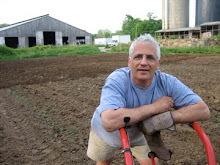
Farmer Brown pays a compliment. "Tomatoes are looking good," he observes. I'm looking up at him, and from my vantage point a story below, he looks weary as he explains that he and his crew had put up about 450 bales of hay. He needs to make a call, and I have about fifty Cosmo plants to transplant before the rain comes.

Before I leave, I decide to tell him about the snake that slithered by, "Right here! Right where 'Im standing," I say, gesturing with my arms
and hands. I make a raking motion, for good measure... since, at the time, I'm holding a metal rake... just in case the serpent tries to squeeze me. "George, this guy was six or seven feet long. I looked him up. He's a classic example of a Black Rat Snake." I say this with the studied confidence of a veteran herpetologist.

"We just call them Black Snakes." Farmer Brown laughs, "They're all right, except when they get in your house."

"They do?"

"They can come through the stones in the foundation."

"Hmmm. When he came across the path, I just stopped... like I was at the Mystic Draw Bridge. I let him pass. Sort of felt sorry for that fat brown mouse we saw Sunday."

George nods. "He'll find that mouse. And a lot more."

I agree that my tomatoes are looking good. In fact, with the exception of a bumper crop of juvenile weeds, some garden variety pests eating a few bush beans, and a whitish schmutz on a few cucumber plant leaves, the garden is growing beautifully.

I love looking around the garden. On one level, the place is so unfinished, and so many of the things I am doing are a waste of time. They're a waste of time to the efficient farmer. But for me, they are a chance to get to know my field, to try things out.

Like building garden retaining walls.

Like using mulching hay versus black plastic sheeting.

Like placing stones and pebbles at the base of cucumber hills. My little Eddie Bauer Volcanoes.

I love this moment in my life. I love the fact that I am scared totally shitless, and yet I have no doubt. No fear. It's exhilarating, and people I haven't spoken to in years seem to be connecting, and I feel friendly again. So many who achieve commercial success, at one stage or another, become prisoners of commerce. We ignore signs and warnings that it's time to freshen up, to move on. There is only so much life we can live.

I'm committed to starting something new. The business plan is on an 8.5 x 11 typed sheet, and it keeps changing in my head. I guess it's at a scale where I can keep a tiny list of contacts, do most of the work myself, and worry about the rest as it takes off. This is the time in the life of a business that I most love.
I think this is why a garden is such a great metaphor for this stage in my life, and this start-up. It has so much to do with newness and the beauty of new plants.

Buds to blossoms.

Flowers to fruit.


Tuesday, June 8, 2010

Day 21, June 8, 2010


SERPENT IN THE GARDEN!


Honestly, the only temptation I felt upon seeing this common constrictor - a Black Rat Snake - was to capture its image to share. Call me an amateur, but this is the biggest snake I've ever seen in the wild... truly a serpent of biblical proportions. Come to think of it, if my vegetables grow as well as this snake in my garden has grown, then it will be a great season. I know one thing for certain, the plump little gray and brown mice in the barn better watch out!

O.K., so aside from Snakes on a Connecticut Plain, my little farm and I have been really busy. The Bush Beans, on one hand, are thriving... but on the other hand, I am finding that several plants are either randomly deformed, or they're being eaten. Fortunately, the wisdom of Farmer Brown seems to be applying, in that we likely sowed more seeds than we would ever be able use.

On the other hand, the pumpkins are coming up gangbusters. They are hardy seedlings, broad leaves flat against the ground. It looks like new leaves are forming rapidly. Hopefully they will start to run as vines, and smother some of the weeds growing below.

Speaking of weed control, it is a problem. I decided that I would mulch with old hay, which I'm behind on spreading. I traded fifteen tomato stakes to Farmer Brown for some old broken bales of hay in his barn. When I drove by a garden plot he'd planted, I noticed neat rows of black plastic, with healthy plants poking out. Lesson learned, although, if I can get the weeds under control, my garden will be more of a scenic, natural thing.

Looks like we have a name for our new Farm Stand, and the brand of products that will follow. We're not quite ready to release it... still some elements to work out.

Monday, June 7, 2010

Day 20, June 7, 2010


It's one of those idyllic early evenings, and I'm driving Elizabeth to a lacrosse game. Zero humidity. High puffy clouds and a cool breeze on the ground. Elizabeth asks from the back seat, "Dad, do you think in a couple of years you'll be able to get a new ---?"

I cannot make out the last word, so I guess... "Will I be able to get a new job?"

"No. Not a job. A dog!" She adds, "You're already building a new job."

"You think?"

"Actually, you're growing a new job."

Aha! My farm phase is harrowing its way into my kid's consciousness. If only I could get her to come and visit. "It would be fun to get a new dog."

"If you lived on a farm, maybe you could get a horse."

"Maybe," I tell her, thinking to myself that dreams and hope are the cornerstones of a child's innocence. I decide not to tell her that I sometimes dream similar dreams: a hard-working, noble trail horse. One that would allow us to explore the farthest corners of the farm. I dream of the empty barns, slowly filling with new generations of animals. As I work the field by the older barn, I imagine the sound of hundreds of lowing cattle making their way back for milking. The silence at Wychwood is, more often then not, broken only by my imagination. That or the puttering of Farmer Brown's utility cart.

I imagine, though, that gradually, skill, imagination and productivity may create new jobs for new friends. Yet, I can't really explain to Elizabeth that this is not my farm, that I need to do one or two things very well before anyone is about to listen to new ideas.

Everything is quiet for a few minutes. I drive and I think about a yoga instructor once explaining to a class that a Beginner's Mind is the best state of mind in which to master the unfamiliar. With a beginner's mind, there is no fear, only opportunity.

Although I have so far to go, so much to do, I can see how this incarnation is taking on a life of its own. It is a fragile life, a life of promise and potential. Yet there are many tangibles. For example, today I talked to Carol, the graphic designer I have worked with over the years, the one who designed my Mystic Chips logo and packaging. The classic design... the one before Utz changed it. And yet, they kept the original logo... placed it on the back of the bag.

I explain to Carol that I need a logo, some sign concepts for the Farm Stand, and label concepts for glass jars. Afterwards, I talk with a trademark attorney about trademarks for several concepts, and I speak with my old food scientist friend, Barbara, about some product concepts. Barbara is a talented, albeit retired, food scientist. I worked with her for ten years in the soup business during the 1980's.

Isn't it strange? every time I feel this urge to start something new, I call my old friends and colleagues. They're usually in a different stage of life, and it feels to me like one of those super hero movies, usually a sequel. The one, younger, brash super hero is trying to convince the others to come fight an evil villain.

Sometimes they do.

Sometimes they don't.

I feel pretty good about my friends. And so, with nothing left to do, I go to the farm, and plant a flat of red salvia.

Sunday, June 6, 2010

Day 19, June 6, 2010

Farmer Ben now tills soil

By Anthony Cronin

Publication: The Day

Published 06/06/2010 12:00 AM
Updated 06/06/2010 04:46 AM
COMMENTS ( 0 )

Ben Greenfield's been a lot of things: marketing promoter, entrepreneur, product developer, snack-food inventor.

And now he can add one more: farmer.

Greenfield, a Noank businessman who created, among other things, Mystic Chips - later sold to Utz Quality Foods in Pennsylvania - has taken up cultivating about a half acre's worth of farmland at Wychwood Farm.

The site, in Greenfield's own words, sits on "600 of the most beautiful acres of farmland in Stonington and North Stonington."

Greenfield has also taken to writing a daily blog about his adventures down on the farm. It's found atwww.somecountryforoldben.blogspot.com. Greenfield says his son dubbed the Web site name, a take off on the novel-turned-movie, "No Country for Old Men."

"It's a great movie," quips Greenfield, though it bears no resemblance to the farming life.

Since late May, Greenfield has gone to the Wychwood property and tilled it, nurtured it, seeded it - and hoped for the best.

Despite some initial challenges, both from Mother Nature and from the fledgling farmer, the crops are growing.

As Greenfield talks on his cell phone about his farming prospects, he walks through his field, describing what's planted: corn, cucumbers, pumpkins, beans, tomatoes, herbs, even onions. He's planted quite a bit in his half-acre plot, and he's excited about the prospects of his crops growing into marketable goods.

In fact, he says that the Wychwood Farm's owners have given him the green light for a summer produce stand at the farm's entrance on Route 201, which Greenfield hopes will be populated with the products of his hard labor (his girlfriend, Debbie, also helps out as much as she can, he points out).

Greenfield says he's grateful to farm owners George and Ann Brown. He says he visited several farms before "Farmer Brown," as he calls him, agreed to let him test his budding agrarian skillset. That was, of course, as long as Farmer Brown's wife agreed - and she did with a smile.

When Greenfield was attempting to explain why an entrepreneur and snack-food inventor wanted to work the land, he handed her a bag of Mystic Chips.

As Greenfield writes in one his early blogs, he told her, "I like to create products that have real roots, and would like to say that I at least took the time to learn how to raise food before selling it."

And, for the first time in a decade, Greenfield says, "I'm getting the feeling that the craziest of plans somehow have a way of taking on a sensible life. For me, it means there is promise, once again. I believe that if I want to, I can create once again!"

Greenfield, ever the inventor-entrepreneur, has plans to create a candy-related product. He can't say too much, what with all the competition these days, but he's already trademarked a popcorn-related product, which is why he's growing a popcorn-variety seed in the Stonington soils.

He also considers creating a mean batch of salsa. "Maybe Stonington Salsa," he says, almost rhetorically. You need good, beefy tomatoes for that - so he's growing them. "There's always room for more salsas," he says.

"Everything I've done," Greenfield reflects, "has come from the sea or farms." When he was creating and distributing Mystic Chips, he says he visited plenty of potato farms.

"I just realized that if I could find a farm and learn some of the ancient arts of growing things - my mother always said I had a green thumb - at least I'd have some integrity to the (food) products I'd like to bring out," he explains.

Greenfield admits that he loves to write, hence his prolific blogs about his agricultural adventures. "I just thought it would be a nice way of chronicling what I'm doing, sort of one person's story about how I was able to get this new business going - or that I had fun trying."

Greenfield says he enjoys his new offbeat pursuit. It is, however, hard work, he stresses. He says he relishes the Browns' common-sense help and their reservoirs of farming wisdom. "We really get along well. They share a vision for doing things right. It's all got to be done slowly and in 'Yankee' time."

In the meantime, the farm is still inviting to Greenfield, the land is receptive to his plantings, and, who knows, maybe he'll have plenty of hearty stock to stack up at the hoped-for produce stand at Wychwood Farm this summer.

"If I can adapt the skills I've learned over almost 30 years and put them into the practical aspects of learning how to bring things up from the earth, then I'll really have fun," he says.

Anthony Cronin is The Day's business editor.

Saturday, June 5, 2010

Day 18, June 5, 2010


The day begins with a deluge. The sky is clear behind the storm. Deb and I want to accomplish as much as possible, and so we load the lawn mower into my car and head out to the farm. On the way, Thompson Lumber Mill calls. My 117 tomato stakes are ready. They're open till noon; We simply need to get to Hopkinton, Rhode Island in time. We unload the lawnmower at Wychwood.

Farmer Brown and Ann stop to chat. We talk about the Sunday column in The Day, the farm stand, and soil quality. Farmer Brown thinks I might be wise to send in soil samples to University of Connecticut. He believes it's best to know the soil you're working with. Of course, I'm looking at a field filled with thriving plants... but I will follow through on his advice.

Once we get to the saw mill, we find a bundle of 120 freshly-milled five-foot tomato stakes. Each is sharpened to a sharp point and strapped into what looks like a horizontal Malaysian man trap. Once we get the bundle opened, Debbie starts loading them into my car. The owner of the saw mill is impressed at how I have been able to get Deb to do "the heavy lifting." He tells me how he had a woman working a machine, and that her firewood splitting skills were nearly twice that of the average man.

Inside the office I pay for the stakes, which cost seventy three cents apiece. That's roughly one-third the cost of what Home Depot charges for an inferior version. Often, I believe, the little guy... the local guy... can do a better job, and save you money. In fact, the flats of plants I bought in Norwich, at Malerba's, came with a commercial quantity discount. Eleven dollars per flat! Compare this to Home Depot at roughly $27.00 per flat. A flat of plants, for the uninitiated, is eight trays of either four or six plants.


We arrive back at the farm at around 1:30. I drive about a hundred stakes and clear out the ancient hay that Farmer Brown said we could take for mulch. It has been composting, outside the new barn, for a few years. I shovel it up in heavy soggy, blackened mats and place it among the tomato plants. I think it will keep the weeds down. They're becoming annoying.

Debbie spends most of the afternoon clearing weeds, planting sunflower seeds and snapdragons.

"Do the snaps work?" I ask her, squeezing one of the blossoms. I liked playing with snapdragons when I was a kid. In fact, they were my favorite flower.

"Hmmm." Deb responds. "I wonder if kids even know about snapdragons any more." she wonders.

There's something sad about a world where kids don't play snapdragons. I think about it as I trim overgrowth along our garden path with my old red lawnmower.

# # #

Day 17, June 4, 2010


Field Trips. Media. More Sprouts!

Debbie wants to show me a classic example of a farm stand turned
community fixture, turned tourist attraction. So I agree to meet her at Bishop's Orchards Farm Market, off of Exit 57 in Guilford.

Bishop's has been in business since 1871.
The business apparently started as a farm stand, evolved into wholesale, and soon after their centennial, I-95 came along.
Rather than bemoan the minor annoyance of loss of land to the interstate artery, it would
appear that a cagey Bishopian generation decided to leverage location with commercial opportunity. Voila! We soon have a mini Stew Leonard's in sub-suburbia.

I get there a little early, wander around on my own. My only purchase is a copy of the State-sponsored DVD, "Working The Land, The Remarkable Story of Connecticut Farms & Farmers." We taste a few of Bishop's fruit wines. Debbie buys a couple, because, honestly, some are quite good.
All in all, I'm impressed with the store,
the crowds, and the loyalty of their customers. I leave knowing that my work is cut out for me. But I'm energized knowing that there seems to be a willingness among consumers to seek fresh products and unique experiences.

Earlier, I receive a call from Tony Cronin, Business Editor of The Day newspaper. He wants to fact check an article he's written about my farming venture for his Sunday, 6/6 front page Business Section column.

We make it out to the farm about 7:30. Too late to really do anything but walk the silent field. There's an evening haze; sort of feels like the fog a few miles away, on the shore, is sitting in a gate, waiting to be released. Soon it will rush up the country roads, I imagine, spilling over the field, bathing my young plants in briny moisture from the sea. Never need to put salt on my vegetables, I muse. Nature's done it! In reality, I realize that the land here has its own micro-climates, that mist and fog is not limited to the sound, is not the province of rickety yacht clubs and bleating light houses. In fact, I'll bet there's fog hiding behind that stand of trees right over there, or maybe inside this big ancient dairy barn.

When it coms to being lost in the fog, the mind - at least my mind - can be like this. In the evening, in the middle of a country corn plot, I dig my finger into a row of popping corn that I just planted a few days ago. The first seed I extract has two hearty growths coming from it. One I suspect is a root, and the other the shoot. My Jane Goodall training has just become useful in helping with plant terminology. However, since I cannot get this nifty little film clip on gravitropism to properly download, here's a link on the subject, along with my own germination progress photo:


file:///Users/bengreenfield/Desktop/corn%20germination.webarchive


# # #


Thursday, June 3, 2010

Day 16, June 3, 2010


Thursday. Early morning. Our Chevy High Cube Van is partially loaded with three short pallets of potato chips. Make the deliveries quickly and then head out to a second generation saw mill in Hopkinton, Rhode Island to buy stakes for the tomato plants. As I drive up, I can see continuous streams of wood chips and saw dust pouring from the building's cock-eyed rusty rafters. It's a pre-apocolyptic setting, but friendly and businesslike.


I believe I need five foot stakes, and they have only twelve of them. I decide to take these, see how they work, and come back for the additional 117 that I'll soon need.

After the saw mill, I drive to Malerba's, in Norwich. This is the coolest nursery I've ever been to. Their plants are healthy. So far. The people there are friendly, but not sycophantic. It's amazingly busy.
I'm looking for traditional cutting bed flowers. We already have the zinnias, and so Debbie and I decided to find cosmos and snap dragons as a beginning assortment.

I notice that Malerbas is running out of product. The green houses- aluminum frame and heavy plastic - are emptying out. A complex vascular array of piping and tubing litters the seedling tables. I cannot imagine the care and coddling that goes into the production of these plants.


I buy four flats of flowers and head back to the farm.

By the blunt side my medium stone hammer, the stakes
go snugly into the soft soil. The saw mill has used what they call a "pencil sharpener" to fashion a tip on each stake. I suspect that, in fact, these tomato stakes might work well against the cold heart of a vampire. If need be.

Nearly half of the field is still barren, with the exception of a clover-like green ground cover. This is where the beans, corn and pumpkins are seeded. When will all of this burst forth? I wonder. After staking a dozen of the giant cherry tomato vines, I wander over to the seed plots.

First there are the bean rows. I find a few stray white beans on the ground. Each is swollen, and a tiny root protrudes. I poke my index finger into
the soil, and transplant these neophyte seedlings.

At the pumpkin patch, I stand smiling into a strong breeze. I can hear distant thunder, but there is no rain. The spirit of pumpkin seed, I imagine, has taken hold. But, alas, The Raven, it appears has stricken. I notice that the stray seeds on the ground have been chiseled open on one end, and the meat extracted... as only a bird can.

Curiosity goads me to check below ground. I find that our pumpkin seeds are in the early stages of germination. A fine strand is emerging from our flat seeds. In a day or so baby vines will be competing with the the ragged ground cover.

There are still sixteen hills to be shaped and an equal number of cucumber sets to be planted. As I start to shape the first, my phone rings. A reporter. Wants to talk about this blog, and likely assess my sanity in this latest incarnation.

"Are you at the farm, Ben?" he asks.

"I am. Speaking to you from my cucumber patch."

After the interview, I come back to solid soil. I stow my phone in the right pocket of my muddy shorts. I finish planting the cucumbers.